
Streaming and the Era of On-Demand Media
By Kevin R. Donley, kevin@multimediaman.org

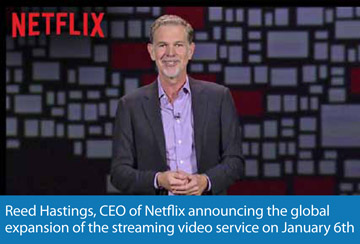
On January 6th, Netflix went live with its video-streaming service in 130 new countries across the globe. The expansion— covering most of the world except for China—was announced by Netflix cofounder and CEO Reed Hastings during a keynote speech at the International Consumer Electronics Show in Las Vegas. Hastings said, “Today, right now, you are witnessing the birth of a global TV network.”
Prior to this latest announcement, Netflix had 40 million subscribers in the US and 20 million subscribers internationally in a total of 60 countries and available in 17 languages. According to Hastings, the company’s goal is to reach 200 countries by the end of 2016 and sign up 90 million US and 450 million worldwide subscribers.
The rapid expansion of Netflix is part of the transformation of TV program and movie viewing that has been underway for a decade or more. While “linear TV”— programming that is presented at specific times and on non-portable screens—is still popular, it is being rapidly overtaken by the new personalized, on-demand and mobile subscription services like Netflix.
According to Netflix, the growth of Internet TV is driven by (1) advancements in Internet reliability and performance, (2) time and place flexibility of on-demand viewing and (3) accelerating innovation of streaming video technology. A possible fourth driver of Netflix’s success is its subscription-based user model. Unlike previous on-demand solutions that often required consumers to purchase one at a time—or rent for a specified period of time—their own copies of movies and music, streaming media solutions like Netflix offers subscribers access to their entire content library without limitations for a monthly fee.
Streaming media refers to video or audio content that is transmitted in a compressed digital form over the Internet and played immediately, rather than being downloaded onto a computer hard drive or other storage media for later playback. Therefore, users do not need to wait for the entire media file to be sent before playing it; the media file is delivered in a continuous stream and can be watched or listened to as soon as the playing process is able to begin.
Media streaming originated with “elevator music” known as Muzak in the early 1950s. It was a service that transmitted music over electrical lines in retail stores and building lobbies. The first efforts to stream music and video on computers and digital networks ran up against the limitations of CPU performance, network bandwidth and data stream interruptions associated with “buffering.”
Attempts in the 1990s by Microsoft (Windows Media Player), Apple (QuickTime) and RealNetworks (RealPlayer) to develop streaming technologies on desktop computers made important breakthroughs. However, each of these solutions required proprietary file formats and media players that resulted in an unworkable system for users.
By the early 2000s, the adoption of broadband internet and improvements in CPU and data throughput along with efforts to create a single, unified format led to the adoption of Adobe Flash as a de facto standard for streaming media. By 2005, when the social media and video sharing service YouTube was established, Flash became the dominant streaming technology on the Internet. More recently—especially since 2011—HTML5 has advanced as an international standard on computers and mobile devices and it will eventually supplant Flash.
 Streaming media has been transforming the music industry along side of TV and movies. While digital downloads still represent the largest percentage of music sales in the US, they are falling. Meanwhile, streaming music services like Pandora, Spotify and Apple Music have already overtaken physical CD sales and represent about one third of the industry’s income. Some analysts expect revenue from music streaming to surpass that of digital downloads in the near future.
Consumers and Content
Streaming media has fundamentally shifted the relationship between consumers and entertainment content. During the era of broadcast radio (1920s) and television (1950s), consumers needed a “set” to receive the analog programs of radio stations and TV channels. Meanwhile, audience members had to be in front of their radio or TV—with “rabbit ears” antenna adjusted optimally—on a schedule set by the broadcasters. The cost of programming was paid for by commercial advertising and corporate sponsors.
In the cable and satellite era (1970s), consumers began paying for content with subscription fees and programming was “commercial free.” Along with home recording devices—at first analog magnetic tape systems like VCRs (1970s) and digital recording devices like DVRs (late 1990s)—came an important shift in viewing behavior. Consumers could do what is now called “time shifted viewing,” i.e. they could choose when they wanted to experience the recorded content.
At first, music publishers mass produced and marketed analog audio recordings—records (1950s) and then audio tapes (1970s)—and consumers purchased and owned a library of recordings. These records and tapes could be enjoyed at any time and place as long as there was an audio system with a stereo turntable or cassette player available.
The same was true of mass produced CD audio (1980s) and DVD video (2000s) optical discs. While these digital formats improved portability and their quality did not deteriorate from repeated play—the way that analog magnetic and vinyl did— they required a new generation of optical devices. Portable CD (1980s) and DVD players (late 1990s) addressed this issue, but consumers still had to maintain a library of purchased titles.
With digital downloading of music and video over the Internet, content could finally be played anywhere and at anytime on portable digital players like iPods (2001) and notebook PCs. However, consumers were still required to purchase the titles they wanted to enjoy. Instead of owning bookshelves and cabinets full of CD and DVD jewel cases, downloaded electron- ic files had to be maintained on MP3 players, computer hard drives and digital media servers.
When Internet-based media streaming arrived alongside of mobile and wireless computing the real potential of time and place independent content viewing became a reality. Add to these the subscription model—with (potentially) the entire back catalog of recorded music, TV shows and movies available for a relatively small monthly fee—and consumers began flocking in large numbers to services like Netflix and Spotify.
Streaming Media Trends to Watch 2016
Media industry analysts have been following the impact of these streaming content and technologies and some of their recent insights and trend analyses are below:
Streaming Devices:
- Linear TV content still dominates US households. However, there are signs that streaming media devices such as Roku, Apple TV, Chromecast and Amazon Fire are rapidly shifting things. The adoption of these devices went from about 17% in 2014 to about 28% of US households with broadband internet in 2015 [Park Associates]
Streaming vs. Downloading:
- Online music streams doubled from 164.5 billion to 317 billions songs
- Digital song sales dropped 12.5% from 1.1 billion to 964.8 million downloads
- Digital album sales dropped 2.9% from 106.5 million to 103.3 million downloads [Nielsen 2015 Music Report]
Cable TV:
- The cord-cutting trend—households that are ending their cable TV service—is accelerating. Total households with cable subscriptions fell from 83% in 2014 to under 80% in 2015 [Pacific Crest].
- Scheduled “linear” TV fell and recorded “linear” TV was flat (or even increased slightly) from 2014 to 2015, while streamed on-demand video increased [Ericsson ConsumerLab].
While streaming audio and video are growing rapidly, traditional radio and TV still represent by far the largest percentages of consumer activity. Obviously, some of the cultural and behavior changes involved in streaming media run up against audience demographics: some older consumers are less likely to shift their habits while some younger consumers have had fewer or no “linear” experiences.
As the Ericsson ConsumerLab study shows, teenagers spend less than 20% of their TV viewing time watching a TV screen; the other 80% is spent in front of desktop and laptop computers, tablets and smartphones. Despite these differences, streaming content use is soaring and the era of “linear”media is rapidly coming to an end. Just like the relationship between eBooks and print books, the electronic alternative is expanding rapidly while the analog form persists and, in some ways, is stronger than ever. Nonetheless, the new era of time and place independent on-demand media is fast approaching.



 Spending many hours researching and writing about the transition taking place in B2B direct selling, I have found that the value of networking and relationships still remain paramount. More than a few Decembers ago, I remember a specific deal where a relationship of my father-in-law helped me finish the year strongly.

 At age 16, Adrian obtained a four-year apprenticeship as a metal type compositor with the printer Otto Schlaeffli in Interlaken. He also took classes in drawing and woodcuts at a business school in the vicinity of Bern. In 1949, Frutiger transferred to the School of Applied Arts in Zürich, where he concentrated on calligraphy. In 1951, he created a brochure for his dissertation entitled, “The Development of the Latin Alphabet” that was illustrated with his own woodcuts.
 Along with the modern art and design movements of the early twentieth century, a reconsideration of the largely experimental work of the first generation of sans serif types began in the 1920s. Fonts such as Futura, Kabel and Gill Sans incorporated some of the theoretical concepts of the Bauhaus and DeStijl movements and pushed sans serif to new spheres of respectability.
 In the 1930s, especially within the European countries that fell to dictatorship prior to and during World War II, there was a backlash against modernist conceptions. Sans serif type came under attack, was derided as “degenerate” and banned in some instances. Exceptions to this trend were in the US, where the use of grotesque types was increasing, and Switzerland, where the minimalist typographic ideas of the Bauhaus were brought by designers who had fled the countries ruled by the Nazis.
 After the war, interest in sans serif type design was renewed as a symbol of modernism and a break from the first four decades of the century. By the late 1950s, the most successful period of san serif type opened up and the epicenter of this change emerged in Switzerland, signified by the creation of Helvetica (1957) by Eduard Hoffmann and Max Miedinger of the Haas Type Foundry in Münchenstein.
 This was the cultural environment that influenced Adrian Frutiger as he set about his work on a new typeface as a Swiss trained type designer at a French foundry. As Frutiger explained in a 1999 interview with Eye Magazine, “When I came to Deberny & Peignot in Paris, Futura (though it was called Europe there) was the most important font in lead typesetting. Then one day the question was raised of a grotesque for the Lumitype-Photon [the first phototypesetting system]. …
 Originally calling his type design “Monde” (French for “world”), Frutiger’s innovation was that he designed 21 variations of Univers from the beginning; for the first time in the history of typography a complete set of typefaces were planned precisely as a coherent system. He also gave the styles and weights a numbering scheme beginning with Univers 55. The different weights (extended, condensed, ultra condensed, etc.) were numbered in increments of ten, i.e. 45, 65, 75, 85 and styles with the same line thickness were numbered in single digit increments (italics were the even numbers), i.e. 53, 56, 57, 58, 59, etc.